Sunday, May 25, 2014

Compiler

A compiler is a computer program (or set of programs) that transforms source code written in a programming language (the source language) into another computer language (the target language, often having a binary form known as object code). The most common reason for wanting to transform source code is to create an executable program.

The name "compiler" is primarily used for programs that translate source code from a high-level programming language to a lower level language (e.g., assembly language or machine code).

 If the compiled program can run on a computer whose CPU or operating system is different from the one on which the compiler runs, the compiler is known as a cross-compiler.

 A program that translates from a low level language to a higher level one is a decompiler.

 A program that translates between high-level languages is usually called a language translator, source to source translator, or language converter.

 A language rewriter is usually a program that translates the form of expressions without a change of language.

Wednesday, April 16, 2014

CSV files

Comma-separated values

.CSV files are the common files used in databse management.Interesting thing is ,these types of files can be handleled in many programming lanugges and many databases use this fiile to implement data.

A comma-separated values (CSV) (also sometimes called character-separated values, because the separator character does not have to be a comma) file stores tabular data (numbers and text) in plain-text form. Plain text means that the file is a sequence of characters, with no data that has to be interpreted instead, as binary numbers. A CSV file consists of any number of records, separated by line breaks of some kind; each record consists of fields, separated by some other character or string, most commonly a literal comma or tab. Usually, all records have an identical sequence of fields

Sunday, March 16, 2014

Fragmentation

Fragmentation, in the context of a hard disk, is a condition in which the contents of a single file are stored in different locations on the disk rather than in a contiguous space. This results in inefficient use of storage space as well as occasional performance degradation. Users frequently create, modify, delete and save files. Back-end operating systems (OS) continuously store these files on hard drives, which inevitably creates scattered files. When fragmentation occurs, the OS needs to consolidate stored files to enhance processing efficiency.

Metadata

 Metadata is "data about data".

That is the metadata can be used to identify the information about the data file whetre it is image, webpage , song or any other file system.


Metadata (metacontent) are defined as the data providing information about one or more aspects of the data, such as:

    Means of creation of the data
    Purpose of the data
    Time and date of creation
    Creator or author of the data
    Location on a computer network where the data were created
    Standards used

Network operating system

Abbreviated as NOS, an operating system that includes special functions for connecting computers and devices into a local-area network (LAN). Some operating systems, such as UNIX and the Mac OS, have networking functions built in. The term network operating system, however, is generally reserved for software that enhances a basic operating system by adding networking features. Novell Netware, Artisoft's LANtastic, Microsoft Windows Server, and Windows NT are examples of an NOS.

Operating System

While living in the today tech world we are more acquainted with the word OS - operating system. But when we asked about it? we simply
say it is windows , Linux , UNIX , MAC os or android.
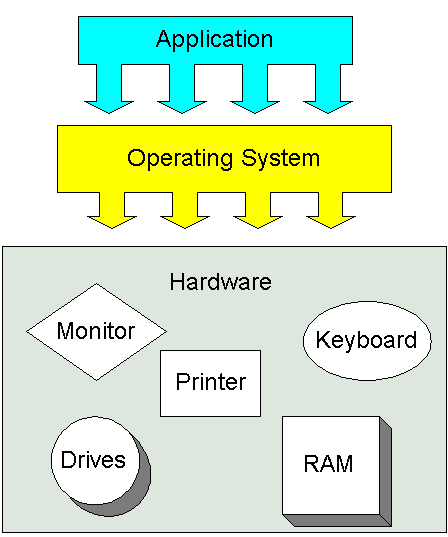
Operating System is a collection of software programs that manages hardware resources and provides an application interface towards user to interact with system.
The components of an operating system:--------

  1. Kernel
  2. Modes
  3. Program execution
  4. Interrupts
  5. Modes
  6. Memory management
  7. Virtual memory
  8. Multitasking
  9. Disk access and file systems
  10. Device drivers
  11. Networking
  12. Security
  13. User interface


Monday, March 10, 2014

Access control list (ACL)

An access control list (ACL), with respect to a computer file system, is a list of permissions attached to an object. An ACL specifies which users or system processes are granted access to objects, as well as what operations are allowed on given objects. Each entry in a typical ACL specifies a subject and an operation. For instance, if a file has an ACL that contains (Alice, delete), this would give Alice permission to delete the file.